








Skip to content
Programmes / Data

Every business runs on data. Does yours run on good data?

When the data is right, work flows. When it isn’t, people chase, check, redo and second-guess. And without good data, you don’t get the value out of AI.

That isn’t a job for the data team alone. It’s a job for everyone. We build data literacy and good data habits at every level, from the person filling in a form to the people setting data strategy.

for: business, data, people and transformation leaders who need good data from everyone, not just the data team
Data / Why it matters

Poor data rarely announces itself.

  1. <01>

    Every decision rests on it

    Pricing, hiring, forecasting, budgets: every decision is only as good as the data behind it. Poor data shows up as a forecast that’s quietly wrong, or a customer chased for an invoice they’ve already paid.

  2. <02>

    Quality starts at the point of entry

    Most data problems are created in small, everyday moments, by people who don’t think of themselves as “data people”. The same client entered three times under slightly different names. Notes that simply say “see email”. Each takes seconds to create and hours to untangle.

  3. <03>

    Data has to be findable and usable

    Stored where people can find it, named so they know what it is, and kept in one version they can trust. Not the report on one person’s desktop, the files called final_v2_FINAL, or the meeting spent debating whose numbers are right.

  4. <04>

    Knowing what you can and can’t do with it

    What counts as personal or sensitive data. What can be shared, with whom, and how. Why pasting a client contract into a free AI tool is a data decision, not just a shortcut.

lesson_frame.mp4
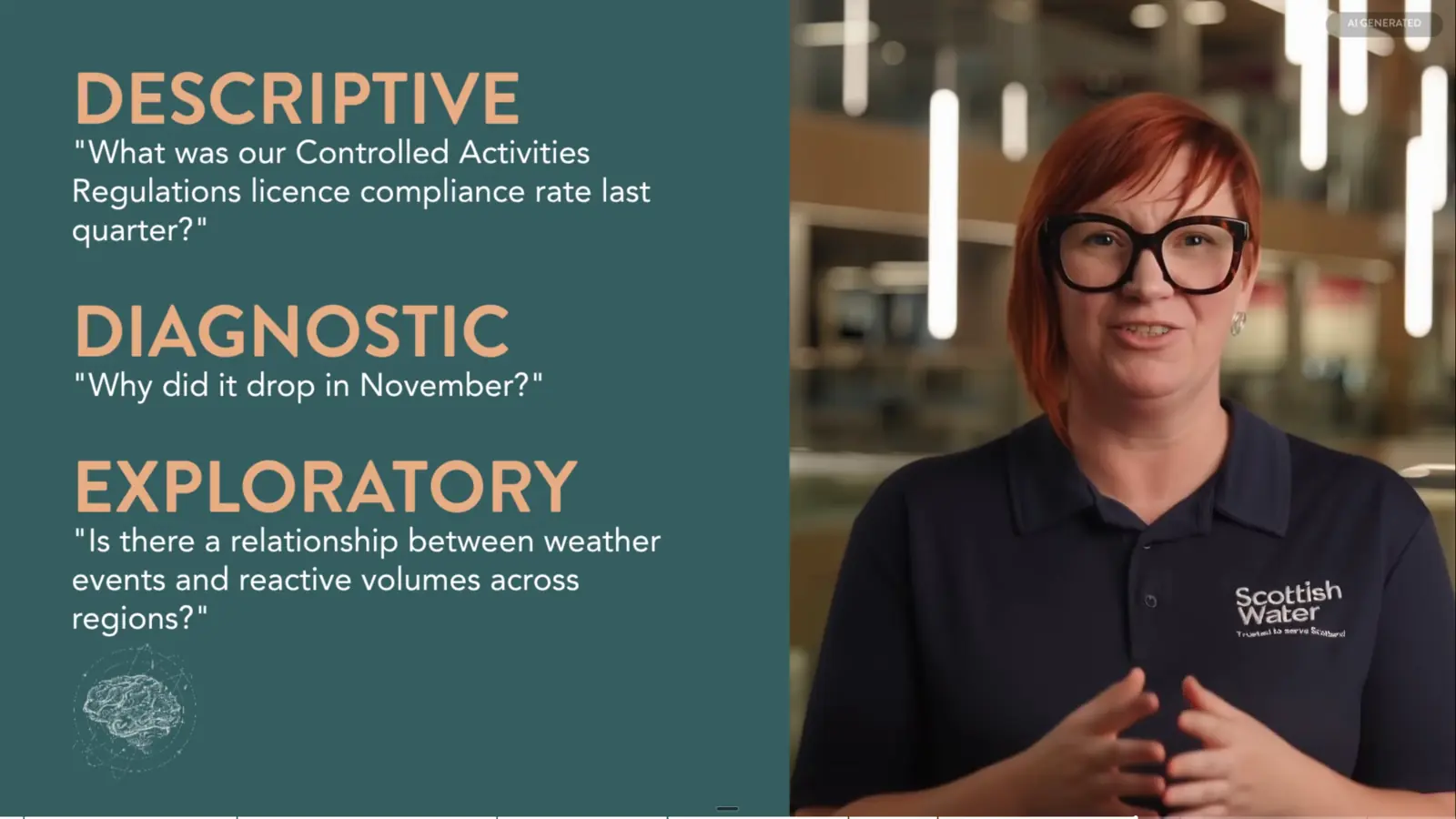
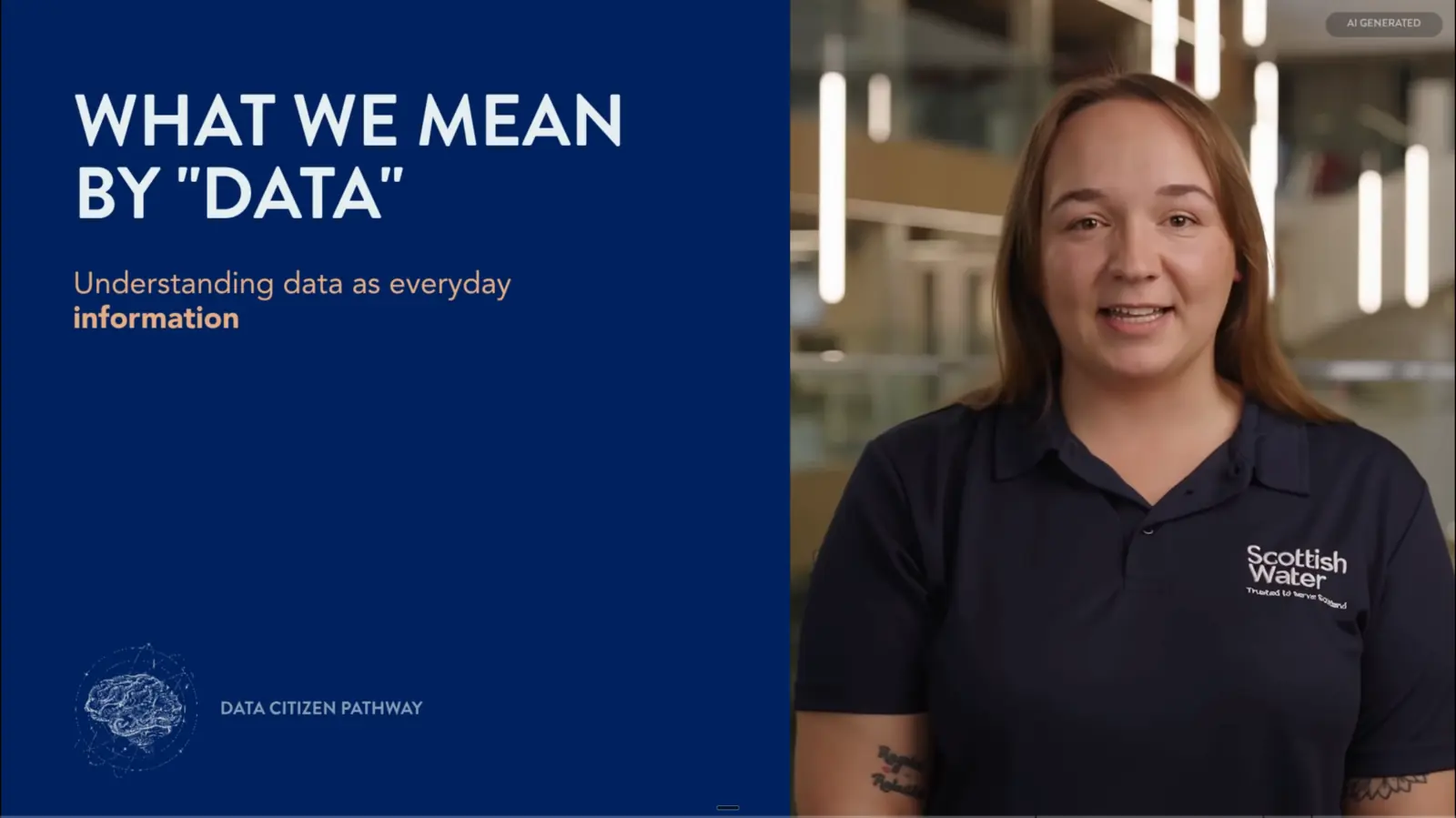
A Scottish Water colleague, as an AI avatar, explaining descriptive, diagnostic and exploratory questions
Data Fluency · Scottish Water
lesson_frame.mp4
An AI avatar presenting a data lesson for DALA Group
Data lesson · DALA Group
lesson_frame.mp4
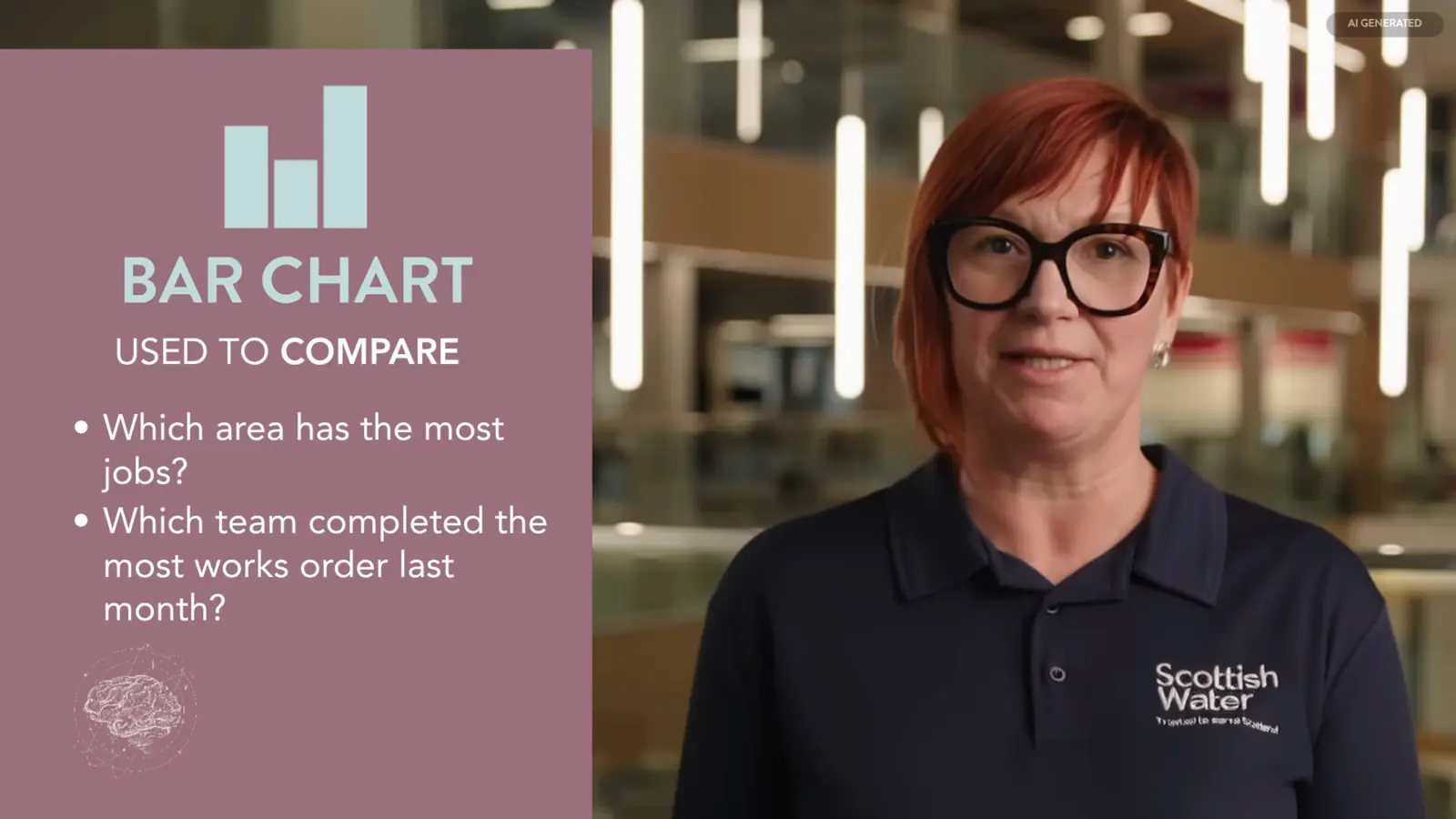
A lesson on bar charts using Scottish Water’s everyday questions
Data Fluency · Scottish Water · built from their examples
data / why_start_now.md

[Why start now]

-

<01>Habits are easiest to set at the start. If you’re bringing in new systems, tools or ways of working, now is the moment to build good data habits in, not fix them afterwards.
<02>Good data is the foundation for AI. Your people are already using AI, and it draws on your data. Without good data you don’t get the value out of AI: good data habits are what make it safe and useful.

--- // the foundation, not the finish line //

Data / Our approach

Too technical for most people, or too generic for anyone.

Off-the-shelf data training is either too technical for most of the workforce, or so generic nobody recognises their own job in it. Yours can be different: it can be built just right for your people.

Off-the-shelf data training compared with the MOLT way
ObjectivesOff-the-shelf trainingThe same content for every organisation, whatever needs to change.The MOLT wayDesigned around what needs to change in how your people work with data.
RelevanceOff-the-shelf trainingSo generic nobody recognises their own job in it.The MOLT wayBuilt from your documents, systems and processes.
EngagementOff-the-shelf trainingToo technical for most of the workforce.The MOLT wayTwo- to five-minute video lessons in plain language, presented by your own colleagues.
Keeping currentOff-the-shelf trainingOut of date when your systems change, and costly to redo.The MOLT wayModular lessons, updated with a prompt rather than a reshoot.
Data / Learner journey

A shared foundation, then a pathway for each role.

Levels, topics and even names are shaped around you, so people recognise their own job in every one.

  1. <01>

    Foundation

    For everyone

    “How do I look after the data in front of me?”

  2. <02>

    Understanding

    For people who use data to decide

    “How do I make sense of what’s in front of me?”

    Typically team leaders, supervisors, planners and managers. Reading dashboards and reports with confidence, and making decisions with data rather than gut feel alone.

  3. <03>

    Insight

    For people who work deeply with data

    “How can I get the most from what’s in front of me?”

    Typically analysts, performance leads and improvement specialists. Starting with the right question, finding patterns, and presenting analysis others can trust.

  4. <04>

    Strategy

    For people who shape how data is run

    “How can I influence how data is designed, owned and used?”

    Typically senior practitioners, data leaders, and governance and compliance roles. Governance, ethics, privacy and architecture, so good data is designed in from the start.

Data / More than a course

Measure behaviour change and business outcomes.

Most learning is judged on who completed it and who passed the quiz. That tells you people know the right answer. It doesn’t tell you whether anything has changed in the business. So we agree up front what success looks like for you.

data / success.md

[What success looks like]

-

<01>More accurate data, with fewer errors, gaps and duplicates entering your systems
<02>More data issues raised and fixed at source, through the right routes
<03>Less rework: less time chasing, checking and correcting
<04>Teams using data confidently in decisions

--- // knowledge checks are the starting point, not the measure //

levels
4
video lessons
67
of learning
~4 hrs
stock voices
0
Read the Scottish Water story

Presented by their own people, in their own accents.

  • Bespoke
  • Engagement

Start growing an organisation that runs on good data.

Every programme starts with a design sprint, to map how data moves through your business and what each role needs. Book a 30-minute call to plan yours.